
Since there’s so much history packed into this relatively small city, we decided to take one of the free tours offered to tourists. A group of “urban docents” leaves from the entrance to the Roman Baths and takes a couple of hours to cover the highlights.

Part informant, part entertainer, part proud citizen, and often (mildly) salacious story teller, each guide becomes a part of Bath in the process of explaining it to us newbies. The city, its abbey and its baths have been attractions for centuries and thus the city has also had a collection of politicians, rogues, hustlers, and celebrities. The guides loved to stop every so often and let us in on the behind-the-scenes realities of different Roman or Georgian customs. It was a fun couple of hours.
As it turns out, there are still baths available in bath, and they’re adjacent to the historic Roman ones – the modern, glassy building below.

We didn’t sample them, but were assured that the spa facilities were very classy. In this part of the city we wandered through a mixture of commercial and retail streets, many of which may have been residential originally but now serve to meet the needs and wants of the waves of tourists that arrive during the day. This Kings and Queens bath sat just a couple of blocks from the main Roman baths but was not open for viewing.
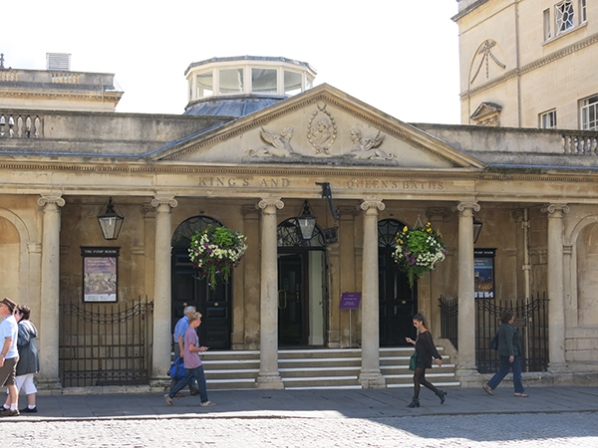
The street scenes below give an idea of the kind of variety we saw in the commercial area – including lots of sidewalk cafes and related activities.


This building is not a great piece of architecture but I took the picture because it was one of the few I saw that was not ‘traditional’ – though it did use the local stone.
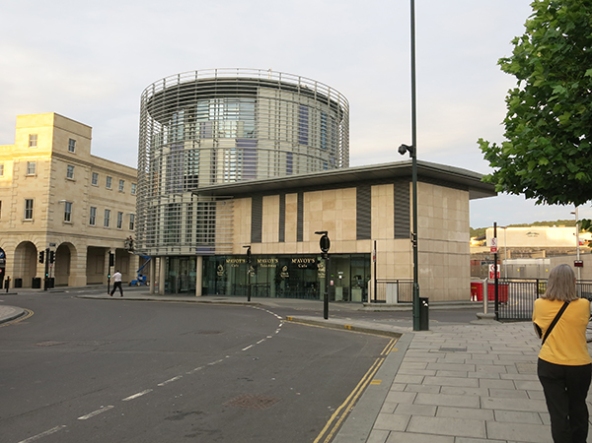
Through a collection of these streets we gradually worked our way up to the first two of the big architectural sites in Bath, the Circus (Circle) and the Royal Crescent. When viewed from the air – or our 3D map, the Circus, along with Queens Square and the adjoining Gay Street, form a key shape, which is a masonic symbol similar to those that adorn many of Wood’s buildings.

The Circus, originally called King’s Circus, was part of Architect John Wood the Elder’s grand vision to recreate a classical Palladian architectural landscape for the city. Other projects included nearby Queen Square and the Forum (which was never built). The Circus is the culmination of Wood’s career, and is considered his masterpiece. (background material from Wikipedia).

Wood’s inspiration was the Roman Colosseum, but whereas the Colosseum was designed to be seen from the outside, the Circus faces inwardly. Three classical Orders (Greek Doric, Roman/Composite and Corinthian) are used, one above the other, in the elegant curved facades. Note the wrought iron fencing above. When these houses were built, the kitchens and servants areas were typically on the lower level and reached via a daylight courtyard between the house and sidewalk. Entrance to the main level of the house was effectively by bridge across a moat.
The frieze of the Doric entablature is decorated with alternating triglyphs and 525 pictorial emblems, including serpents, nautical symbols, devices representing the arts and sciences, and masonic symbols.


The central area was paved with stone setts, covering a reservoir in the centre that supplied water to the houses. In 1800 the Circus residents enclosed the central part of the open space as a garden. Now, the central area is grassed over and is home to a group of old plane trees. Between 1758 and 1774 number 17 The Circus was home to Thomas Gainsborough and used as his portrait studio. The formality of the front facades actually conceals some clever developer devices. The first is that the facades were all developed in a repetitive and consistent manner; but the facades did not control the use of the buildings behind. Though the typical house was three bays wide; you could in fact arrange to purchase whatever width you needed and could afford.
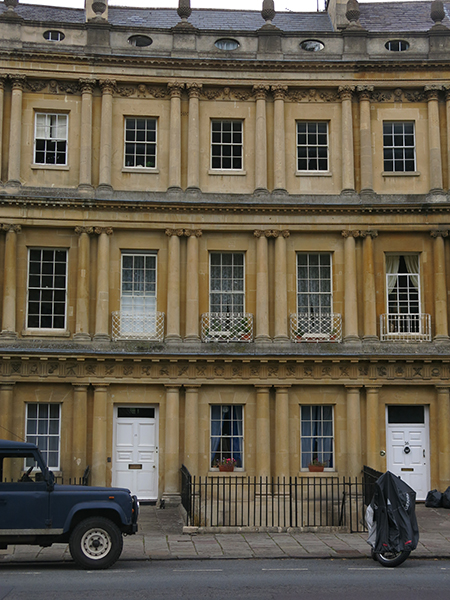
The other is that the rules went out the window around back. Here, you could pretty much have whatever clever extensions and details you wanted.

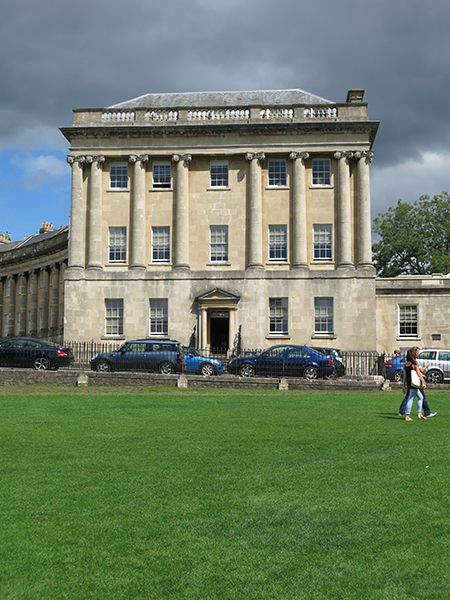
Just a few blocks away, the Royal Crescent is a row of 30 terraced houses laid out in a sweeping crescent. Designed by the architect John Wood the Younger and built between 1767 and 1774, it is among the greatest examples of Georgian architecture to be found in the United Kingdom and is a Grade I listed building. Although some changes have been made to the various interiors over the years, the Georgian stone façade remains much as it was when it was first built.
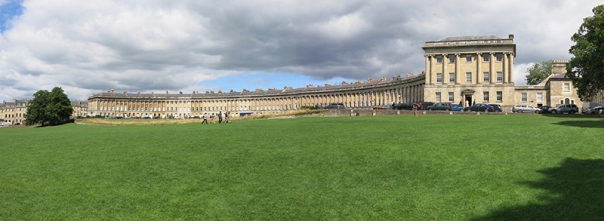
The right hand end of the crescent was originally the end town home of the crescent but has been converted into a Georgian Museum in an effort to convey the lifestyle of that time. We toured the museum (no photos allowed) where people in Georgian dress explained the mores and morals of the 18th century.
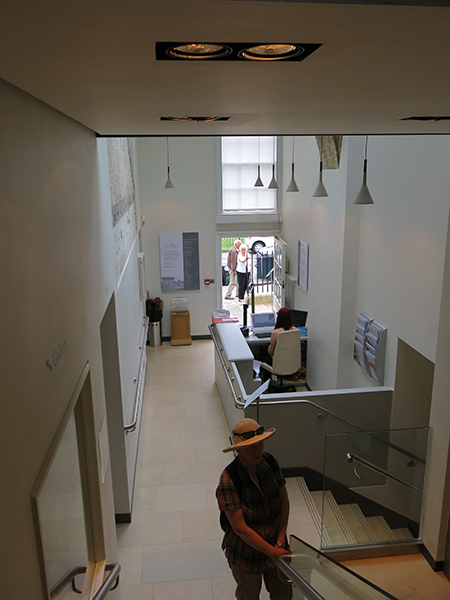
A small outbuilding to the rear of the museum houses offices and information services.

It had been remodeled in an attractive and contemporary manner and also solved some tricky access and storage issues for the main museum building.
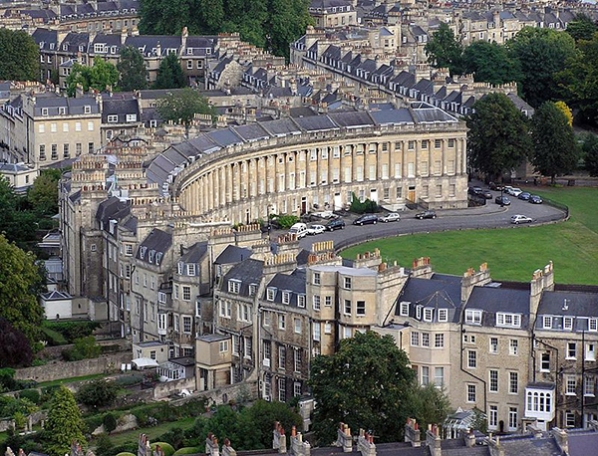
The view below clearly shows the contrast between the formal fronts and individual rears of the homes, similar to those in the Circus – which you can just make out in the top left portion of the picture.
Many notable people have either lived or stayed in the Royal Crescent since it was first built over 230 years ago, and some are commemorated on special plaques attached to the relevant buildings. The Royal Crescent now includes a hotel and a Georgian house museum, while some of the houses have been converted into flats and offices. It is a popular location for the makers of films and television programs.
From this dramatic experience the tour worked its way back downhill to the Bath Assembly Rooms. During the Georgian era Bath became fashionable. The architects John Wood, the Elder and his son John Wood, the Younger laid out new areas of housing for residents and visitors. Assembly rooms had been built early in the 18th century, but a new venue for balls, concerts and gambling was envisaged in the area between Queen Square, The Circus and the Royal Crescent. Robert Adam submitted a proposal that was rejected as too expensive. John Wood, the Younger raised funding through a Tontine and construction started in 1769. The New or Upper Assembly Rooms opened with a grand ball in 1771 and became the hub of fashionable society, being frequented by Jane Austen and Charles Dickens, along with the nobility of the time.
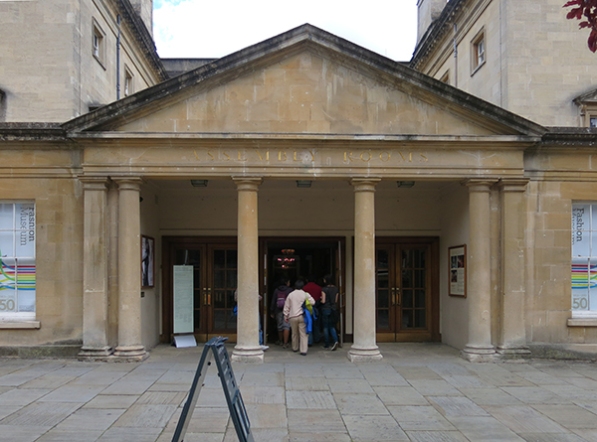
The Bath stone building has rooms arranged in a U shape. There are four main function rooms in the complex: the 100-foot-long (30 m) ballroom — the largest Georgian interior in Bath; the tea room; the card room; and the octagon.
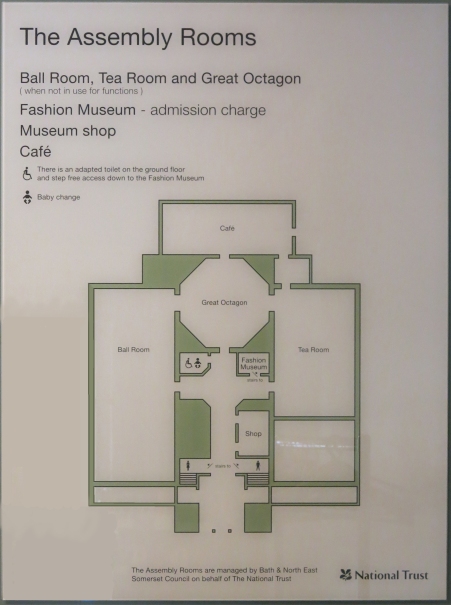
In the 20th century they were used as a cinema and in 1931 were taken over by the Society for the Protection of Ancient Buildings and restored. They were bombed and burnt out during the Second World War, with restoration undertaken by Sir Albert Richardson before reopening in 1963. They are now owned by the National Trust and operated by Bath and North East Somerset Council for public functions. The basement of the building provides a home to the Fashion Museum.
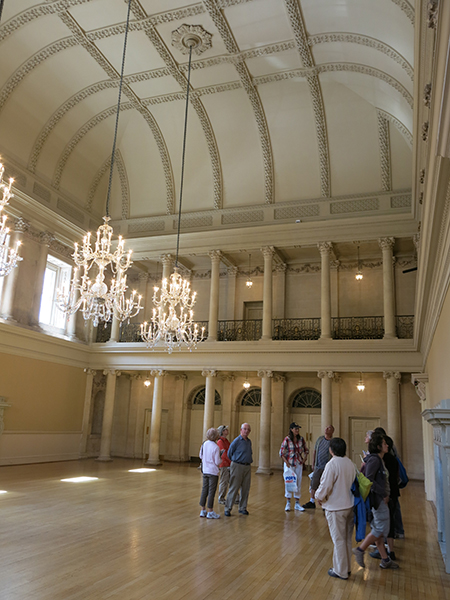
The rooms have Whitefriars crystal chandeliers and are decorated with fine art.

At the end our our tour we worked our way back to the Roman Baths, on the right below, and across from them the Bath Abbey.
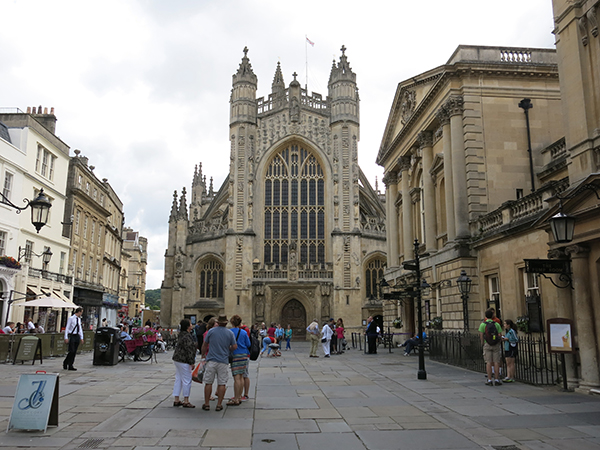
In the view below, taken with the baths behind me, the benches are set up in a rectangle around the ‘busker area’ where musicians, jugglers, and story-tellers entertain tourists taking a break
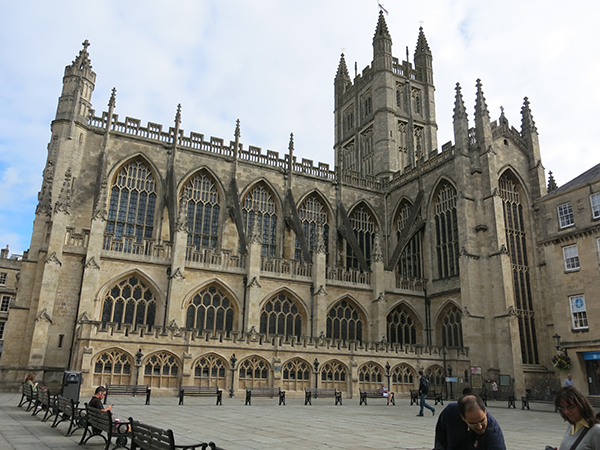
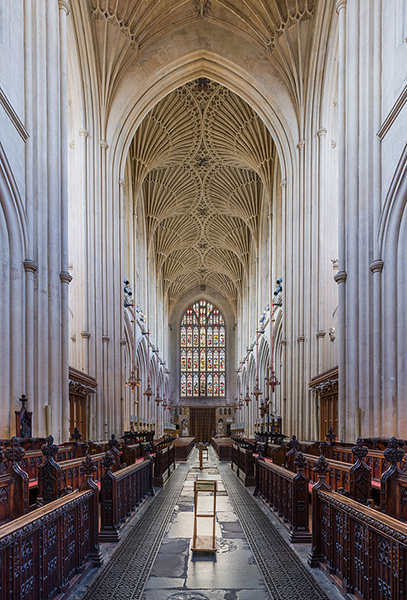
Bath Abbey was a Norman church built on earlier foundations, although the present building dates from the early 16th century and shows a late Perpendicular style with flying buttresses and crocketed pinnacles decorating a crenellated and pierced parapet. The choir and transepts have a fan vault by Robert and William Vertue. The nave was given a matching vault in the 19th century.
Some of the exterior details were attractive – especially here where the stone carving is laid over the lacy glass background.

All in all a very helpful tour.


 Travel Design Impressions