Segovia

The first recorded mention of a settlement in what is today Segovia was a Celtic possession. Control later passed into the hands of the Romans. They left behind the most dramatic structure, the 12 mile aqueduct, of which a mile or so remains.
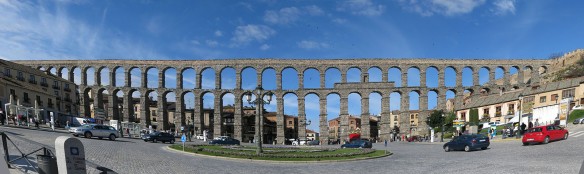
Segovia_Aquaduct_Pan_3_Modify_1000

The bus from the Renfe train station drops you right here; so there’s no question about the importance of this historic structure to the city’s reputation. It’s a bit hard to figure out exactly how it worked from what remains. The origin was a river about 11 miles off to the left of the picture and the terminus was the Alcazar or castle, located a mile or so straight ahead as you’re looking through the arches. To accomplish this the aqueduct makes a turn at the right end of the photo above and then continues in a tunnel for the rest of the length. From the layout of the city today, and the topography, it’s hard to read all of that as you walk around. But regardless, it’s pretty impressive. Here’s a photo of a model of the city that we found in the information center.
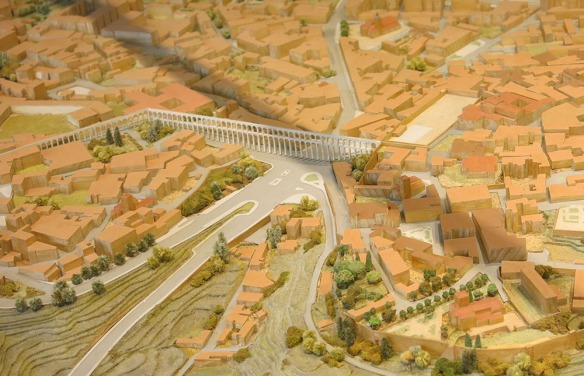
Segovia_Model_1458_1000

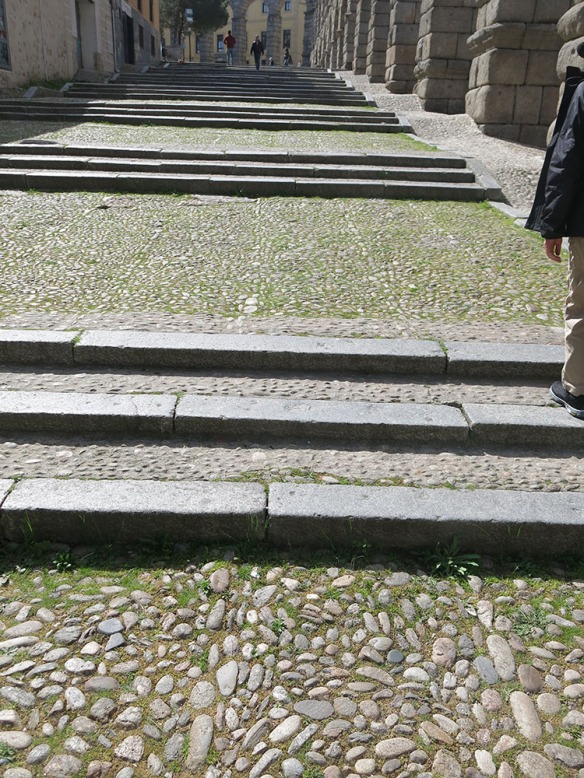
We decided to walk the length of what remains to see how the Segovians live with it. At certain times of day – mid morning here – it casts evocative shadows, highlighting the stairs and slope of the hillside.
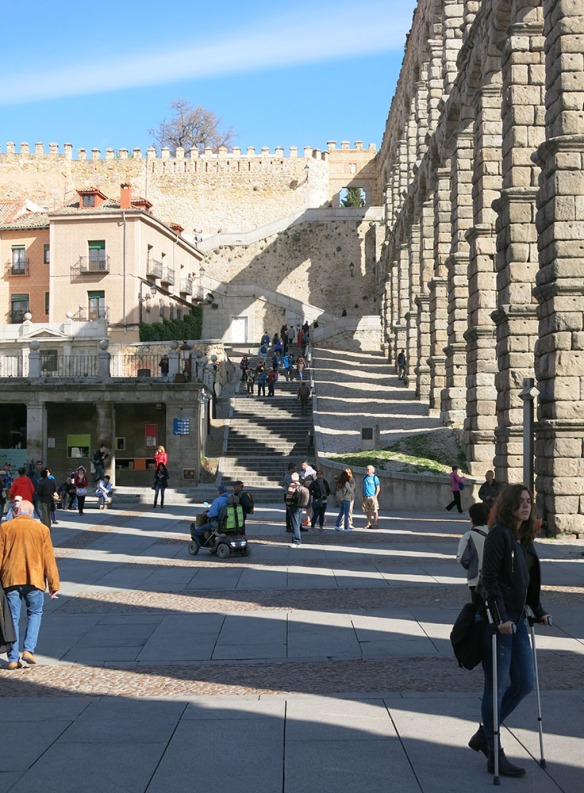
Segovia_Aquaduct_1443_1000

Segovia_Aquaduct_Stramp_1462_1000

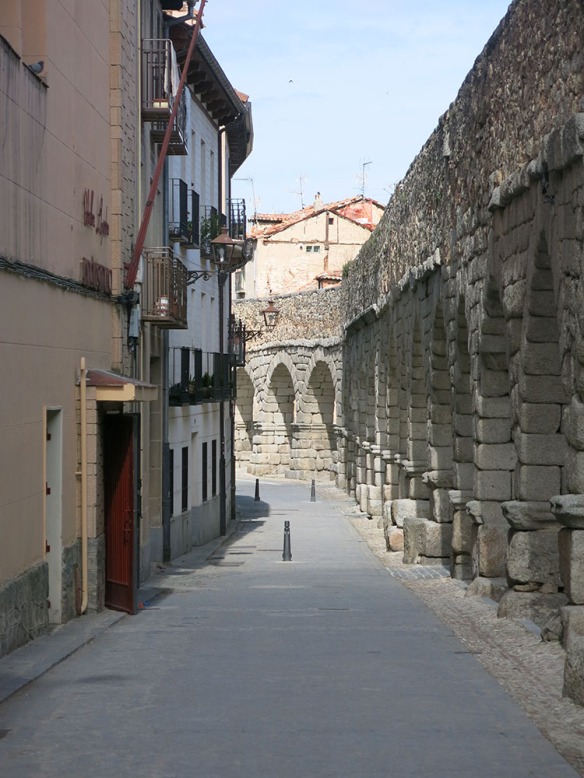
As far as is evident, the city has simply grown up around the aqueduct; but at the same time no other structures have been built into or against it.
Segovia_Aquaduct_street_1471_1000

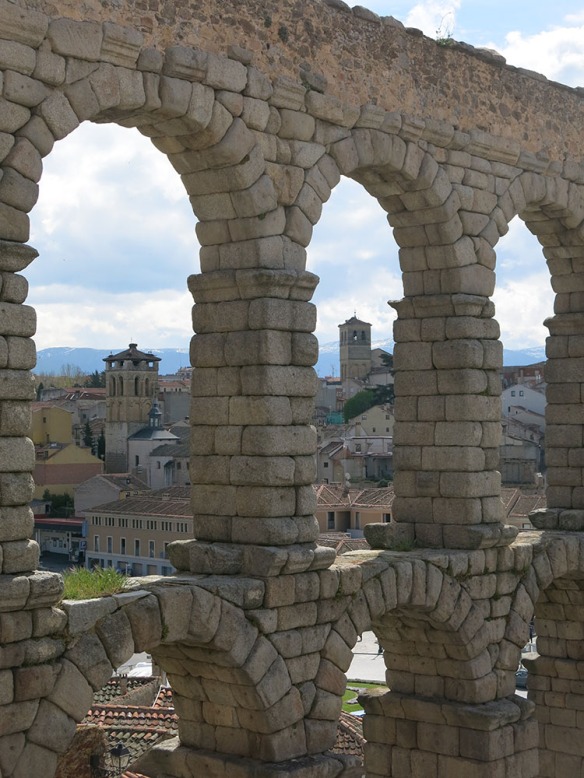
I would have expected the Romans, skilled engineers and builders as they were, to have created curved corners for simpler water flow; but they chose to just create angles instead. From some vantage points the views through the arches focus elements of the city.
Segovia_Aquaduct_1497 _1000

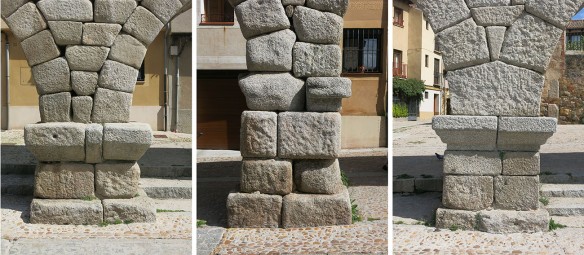
And speaking of engineering, here’s another surprise – the engineers left a lot of the critical decisions up to the stone masons, such as the composition of the arches.
Segovia_Aquaduct_Arch_Comparison_1480_1000

I had initially assumed that the stone patterns, being absolutely critical to the stability of the arches, would be consistent; but then I noticed that some of them varied notably – such as the one in the center. I would also have expected the weight and forces of the arches to be stabilized by a large bottom stone such as at the right; but obviously that was not always the case. But then, it hasn’t fallen for 1800 or so years so it’s hard to complain. We came eventually to the end of what remains.
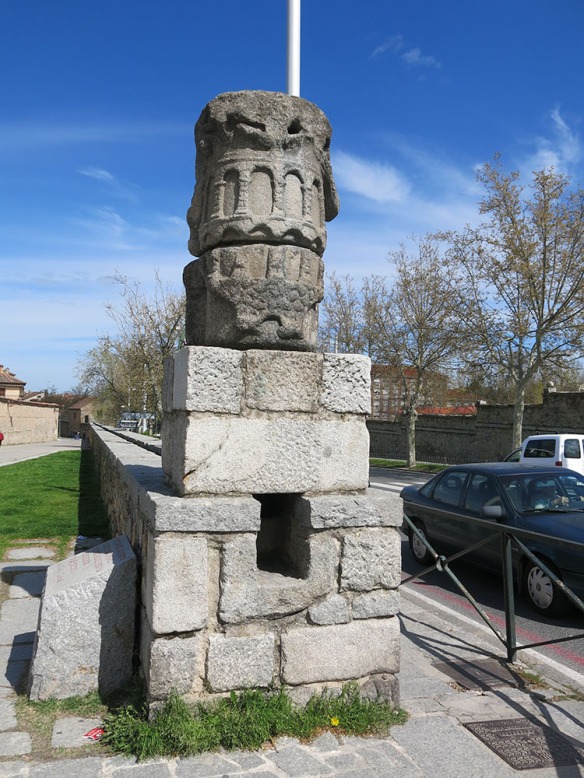
Segovia_Aquaduct_End_1477_1000

There were structures like this every so often, likely for maintenance, where you could even get a view of the channel inside.
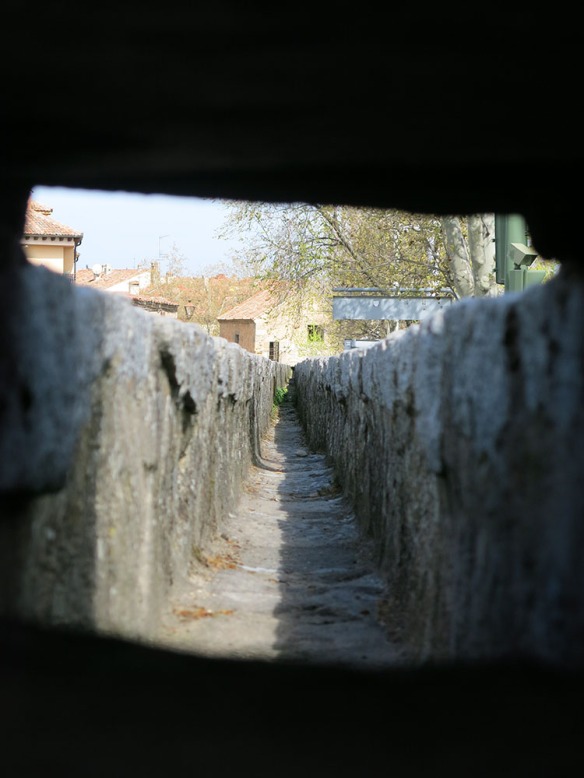
Segovia_Aquaduct_channel_1475_1000

I’m assuming that it was lined and had a top stone to minimize leaks and intrusions from plants, birds and animals. We worked our way back down to the city plaza.
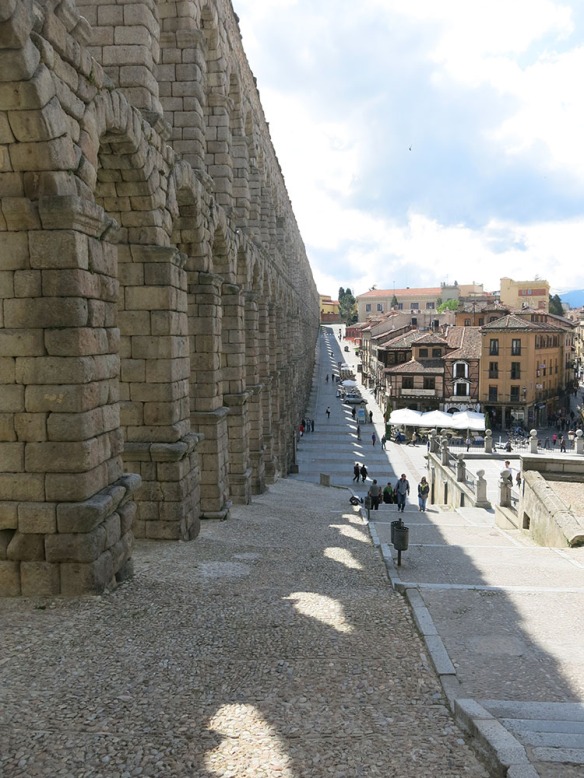
Segovia_Aquaduct_1495_1000

and then up to the other end just to see the whole thing.
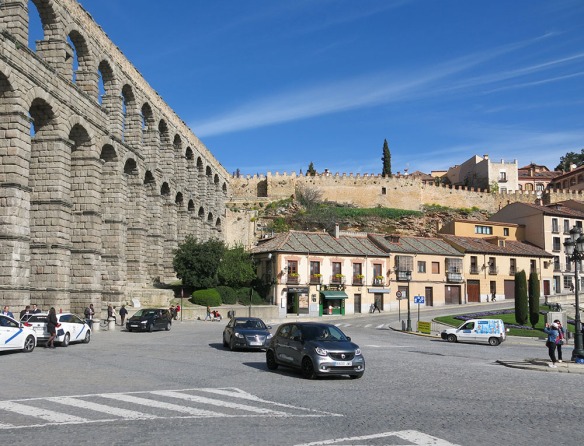
Segovia_Aquaduct_1439_1000

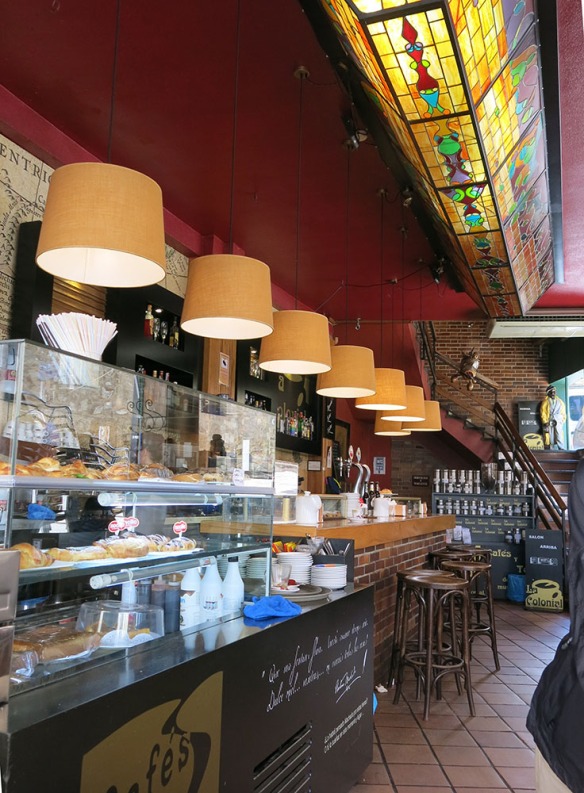
Today it ends pretty much as you see it; but originally it turned and went underground. So we turned and headed down the tourist route to find a cafe con leche, in this case at La Colonial, a pleasant place for both locals and visitors.
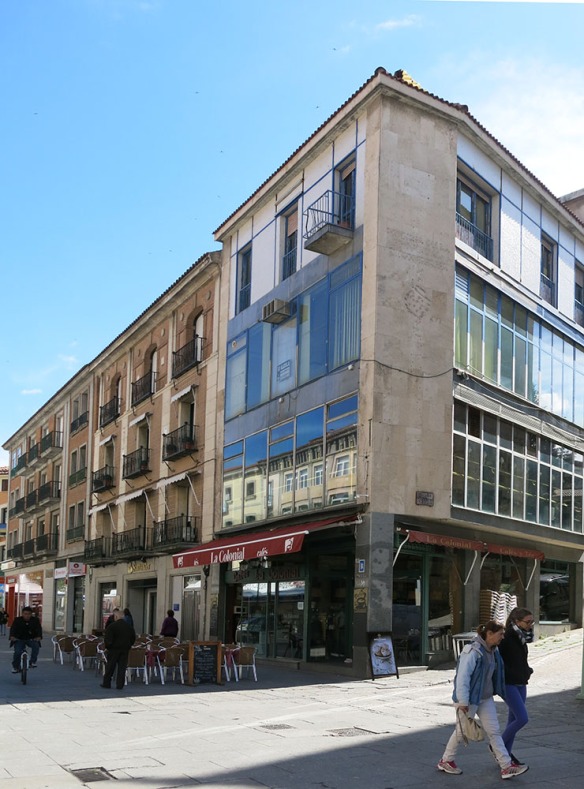
Segovia_Coffee_1451_1000

Segovia_Coffee_1447_1000

Here’s what helps to draw you in.

Segovia_Coffee_1452_1000

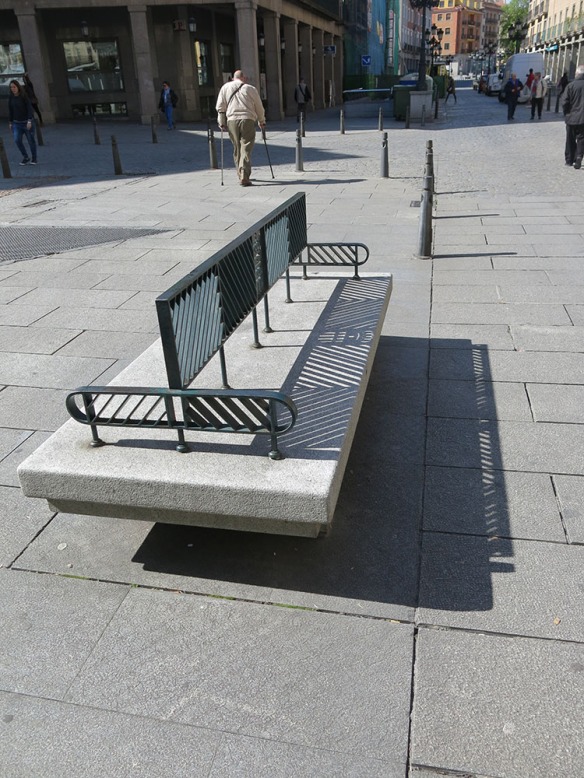
And if you want to sit outside instead you can use one of their tables or one of the benches designed and provided by the city. Nice the way the shadows work.
Segovia_Seating_1450_1000

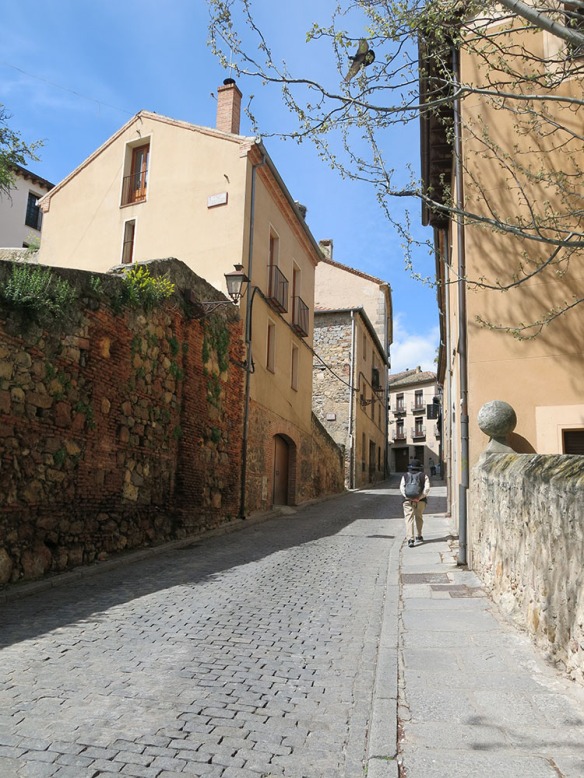
We decided for this hilltop exploration of the rest of the city to work our way around the edges to the Alcazar and then back towards the center to the Cathedral and Plaza Mayor. A lot of this is familiar from other hill towns of course. The streets are narrow and houses are wedged in every which way.
Segovia_Streets_1517_1000

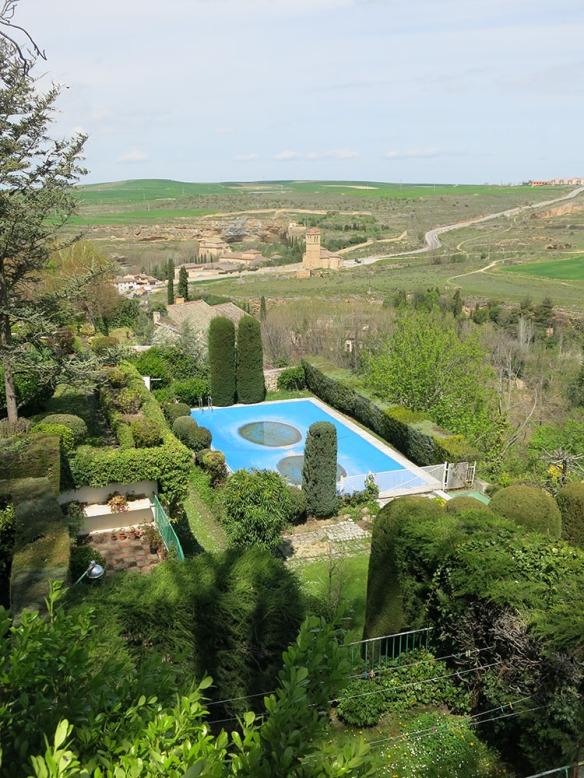
But the views from some of the streets were interesting. Here’s the back of a villa. Must be nice to be able to perch your pool on a steep hillside. Notice that the land in the background is mostly agricultural.
Segovia_HillView_1524_1000

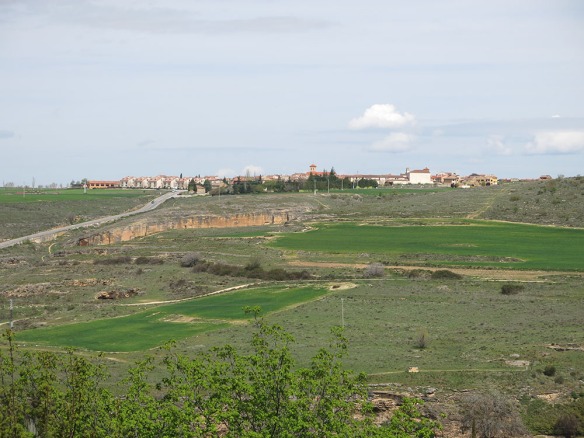
Through planning, good luck and/or a desire to save land for agricultural uses, many of the new towns around Segovia seem to be pretty compact.
Segovia_Hill_NewTownView_1523_1000

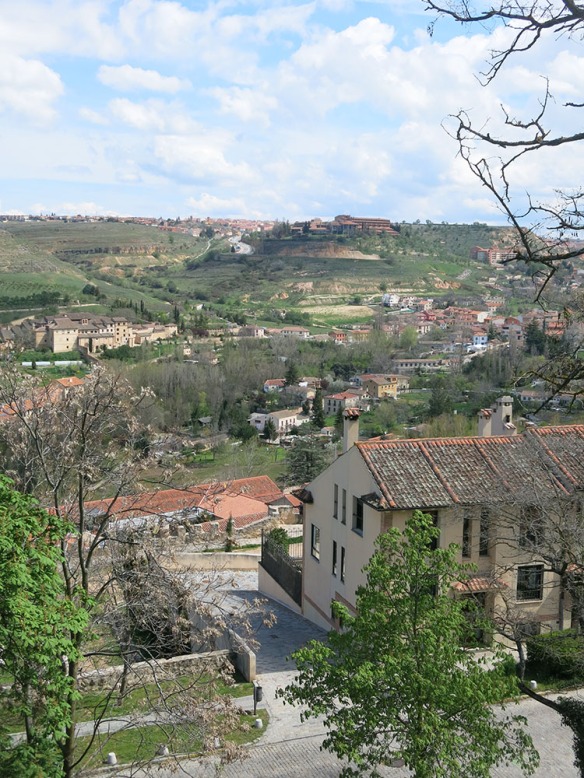
But we also saw areas here and there that had that old familiar car-dominated sprawl.
Segovia_HillView_1511_1000

The desires that have driven Americans for 300 years to keep moving are catching on here and there in places like Spain as well. People like to drive here; and since the narrow streets of the old towns are SO not friendly to driving, there’s a real desire to have wider roads, room to park and to go faster. So while we enjoyed lots of compact cities and towns and the transit that makes them viable, we also experienced the desire to get away from those things and have an (apparently) easier life.

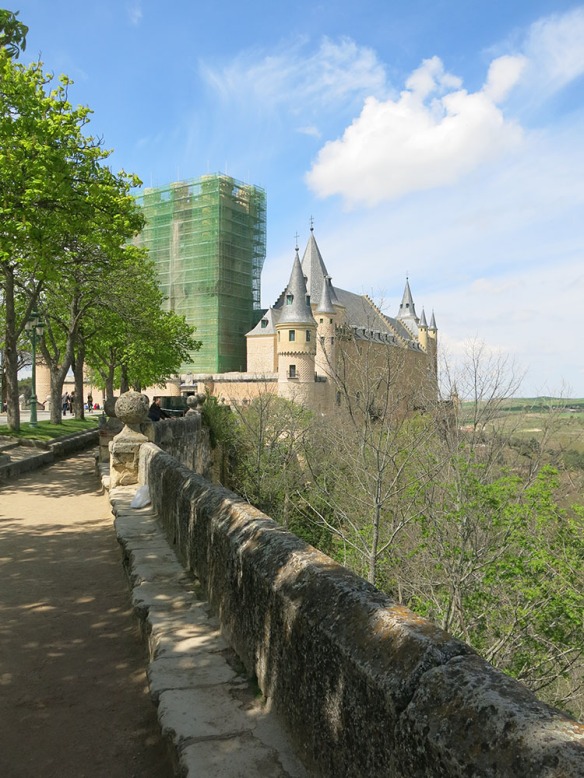
We came to the ‘end’ of the hill and the Alcazar or castle. It was in the middle of some serious repairs so we didn’t go in.
Segovia_Alcazar_1526_1000

A war memorial to a battle in 1812 was set appropriate in the plaza in front.
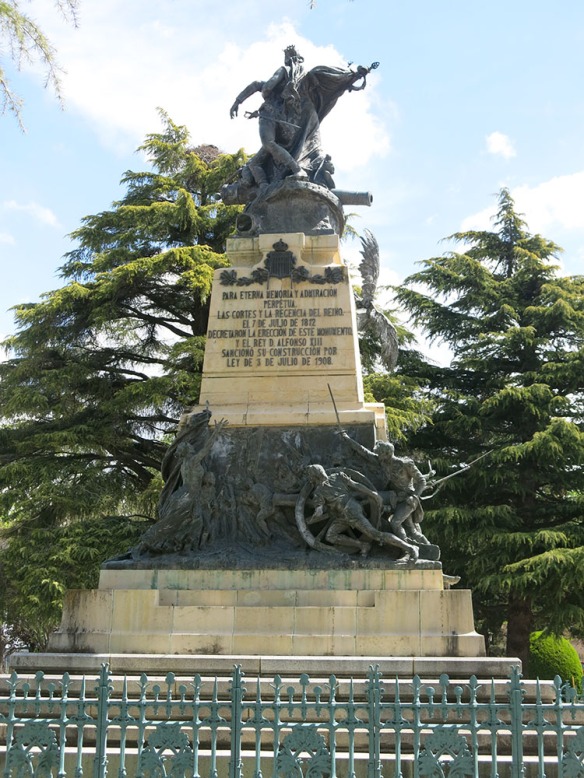
Segovia_Alcazar_1812Memorial_1529_1000

We then skirted the other edge of the hill in the opposite direction towards the cathedral.
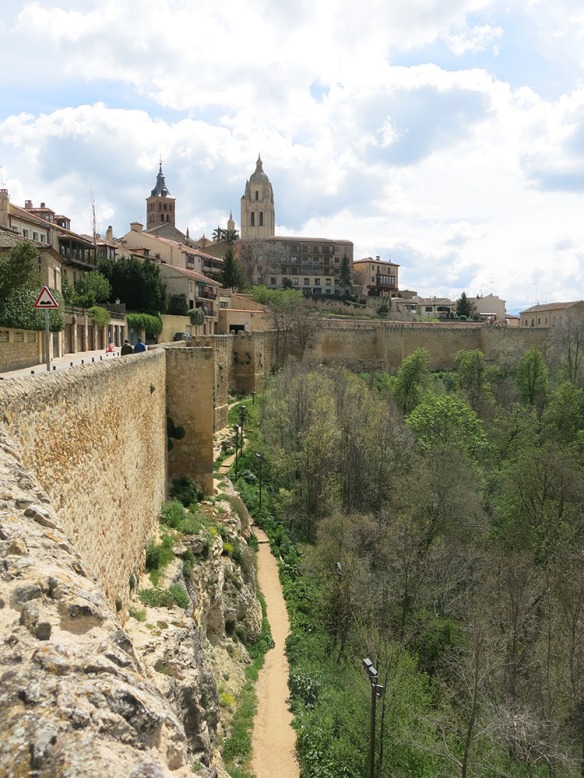
Segovia_Cathedral_1531_1000

The city walls have been lit from below so as to be visible from a nearby road. Newer housing gets to reach a bit higher to catch the view.
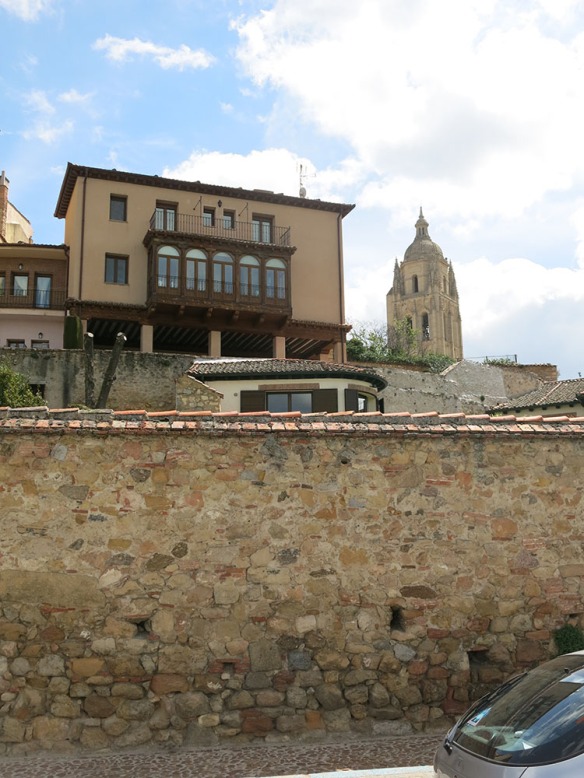
Segovia_Cathedral_1533_1000

And the cathedral periodically catches your eye as the streets align towards it.
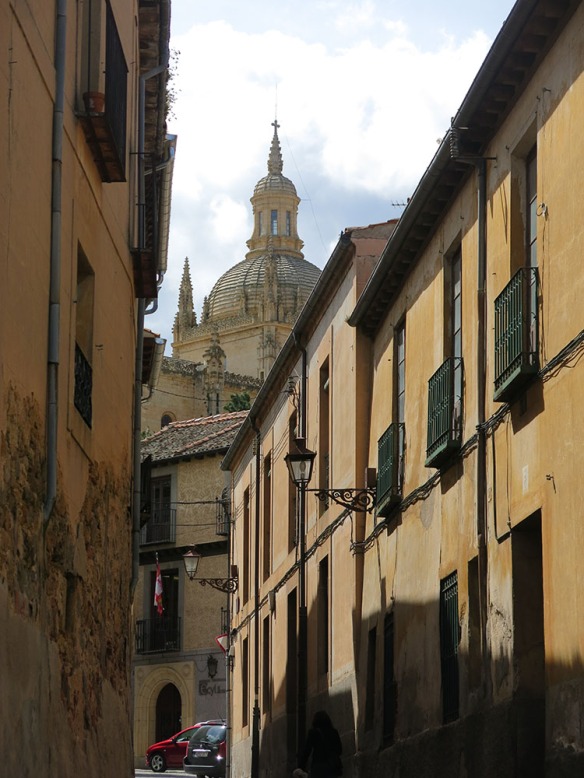
Segovia_Cathedral_1519_1000

You actually approach the Cathedral from the Plaza Mayor. It’s the center of commerce – and now a focus for tourism – for the city, with lots of restaurants and businesses.
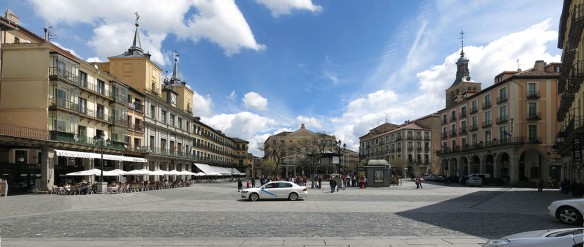
Segovia_Plaza_Mayor_LookN_1000

The Cathedral sits at the opposite end, though not symmetrically oriented towards it.
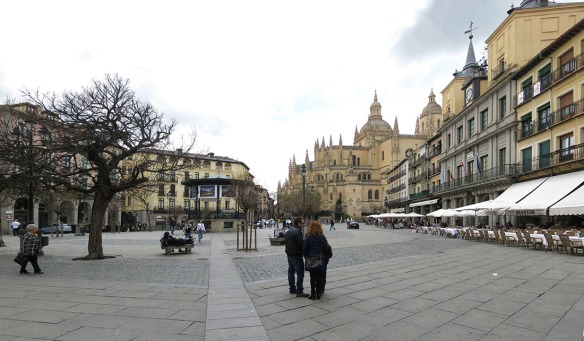
Segovia_Plaza_Mayor_LookS_1000

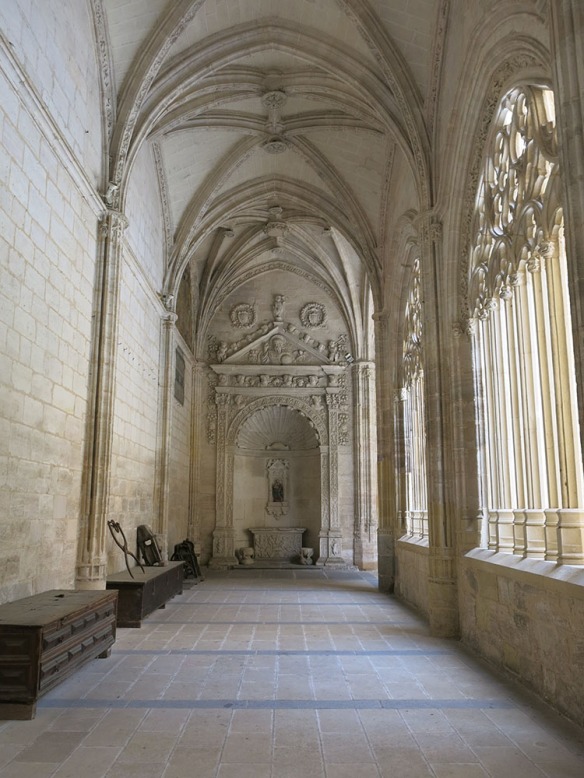
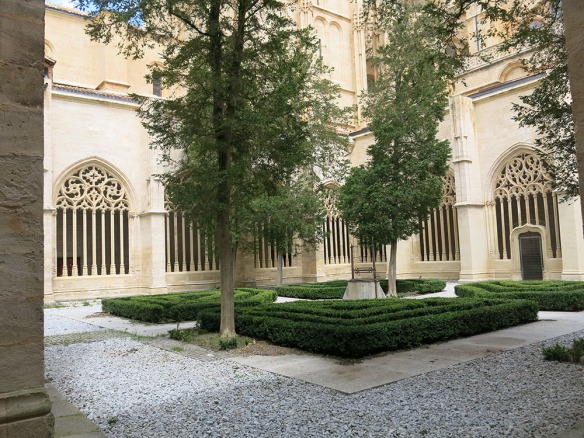
We took a brief tour. Though we’re not cathedral aficiondos, we like to see what the general tone of the design is, since there’s quite a variety in detail. This one is about in the middle of the range.
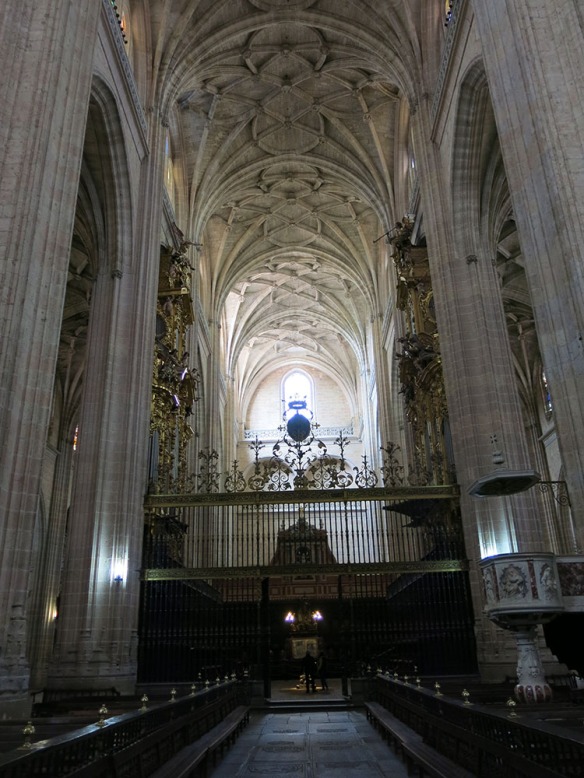
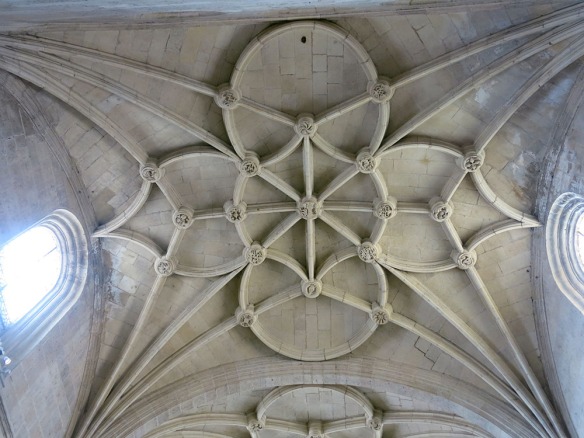
Segovia_Cathedral_1544_1000

Segovia_Cathedral_1557_1000

I personally am more attracted to the cloisters. They seem to embody the sort of contemplation that is appropriate in this setting.
Segovia_Cathedral_Cloister_1551_1000

Segovia_Cathedral_Cloister_1549_1000

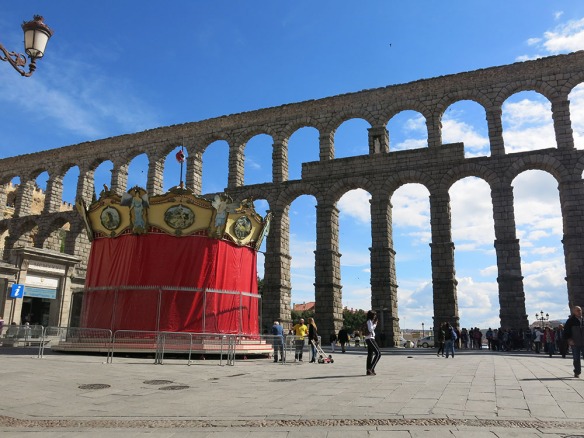
After this visit we made our way back to the aqueduct to catch our bus. It was not without some irony that I noted how the circus of all this tourism washing through town is being celebrated by the 2000 year old Roman structure.
Segovia_Aquaduct_1453_Merry_1000

Back to Madrid !


Gullane, Dunbar, Tantallon

The town of Gullane (“Gull-IN”) and its three golf courses lies about 20 minutes east of North Berwick, along the scenic coast road we drove in on.

Gullane_Sign_0398_1000Gullane_CourseLayout_0394_1000

The championship course (1) is in red, the club level (2) is in white, and the municipal level (3) is in yellow. That’s 54 holes of golf all in one area. As we unpacked we decided that it was probably a good idea that we had signed up as club level players.

Gullane_Golfers_0387_1000Gullane_Golfers_0408_1000

Typically the deal is to unpack and then rent trolleys for the day as Bruce, Roger and Gary have done here. Most of the time our native skills and the scorecard maps get us around without getting lost. The challenge in the early holes is dealing with the hill across the road. Each of the courses at some point takes a hole directly up the hill to the rest of the course – and at the end uses a hole to bring you back down again. Course 1 goes up on the right hand side. On the white course we went up on the

Gullane_UpTheHill_1000

third hole, on the left. Here’s Bruce leading the way. Of course you can’t see where you’re going; you just have to trust that the guide stake has been reasonably located.

Gullane_3rdTee_Bruce_0400_1000

The view at the top looks out over the Firth towards Edinburgh on the right-hand side.

Gullane_16thGreenView_1000

This course was pretty wide open, as shown above. It’s deviousness came around the greens, where pot bunkers awaited your every slightly off-line shot. The trick in links golf is that it’s hard to fly the ball onto the green and have it stay there rather than just run off the back of the putting surface; and at the same time if you run the ball up on to the green (which is common in this style of play) there are a lot of pot bunkers to avoid. And just to make the challenge clear, the ground around the bunkers tends to slope in towards them. You have to be precise.

Gullane_PotBunkerGreen_0411_1000

The overall view back up the hill showed that all three course were generally similar in the way they climbed up and down the slope. We found that at this time of year hitting an occasional shot into the rough was not a big penalty; but we could see that when the rough thickens up in the summer, hitting out of it will be tough (if you can find the ball).

Gullane_LinksSetting_0409_1000

The typical pattern of the courses is to use white flags on the outward nine and red flags coming back in. After playing some downhill, crosshill, and back uphill, we finally came back down the big hill on the 17th, where, if you hit your drive well, all you have left is a chip shot. After this, you cross the road to the 18th tee and finish in.

Gullane_17th_Fairway_0412_1000

That’s the Berwick Law sticking up in the background – to give a sense of where our temporary ‘home’ was. As is generally true in links golf, the town of Gullane wrapped right up to the course.

Gullane_Town_0415_1000

Here’s a shot from the course looking down ‘main street’ and another of the church burial ground immediately to the left and adjacent to the pro shop.

Gullane_ChurchRuin_0416_1000

And in the pro shop – which we always visit (and they know we will) – all sorts of golf equipment with which to make your round complete, including head covers for your drivers to show everyone who in the foursome is the big stag.

Gullane_ClubCover_0418_1000

But to more serious matters – Dunbar.  Dunbar Golf Club lies along the water in the opposite direction, about a half hour to the east. Here’s the clubhouse.

Dunbar_Clubhouse_0456_1000

Unlike Gullane, Dunbar doesn’t have a driving range; so the best you can do is hit a few balls into a net and chip and putt on the practice green to the left. We were surprised to find this at a number of courses. We were also surprised here to find that the greens had been recently aerated (for better drainage) with a type of slicing method.

Dunbar_0474_Greens_1000

This had a distinct effect on putting – bobbles in one direction; wobbles in the other – that you had to just putt through and/or figure on a few bad luck putts.

That’s the 3rd hole on the right and the pro shop, starter’s office in the background.

Dunbar_3rdGreen_ProShop_1000

What Dunbar does have is a giant stone wall running most of the length of the course. You play the first three holes (finishing above) on the west side of the wall and then cross through an opening and play the next 14 on the east side. Here, we’re teeing off on the 4th hole, right next to the wall. Scotland is full of stone walls of this type – fully built with mortar and not just piled up stones as in New England.

Dunbar_4thTee_0461_1000

In our experience the wall was mostly psychological. We came close a couple of times but never went over; and unlike the North Berwick course, we never had to play over it either. Down the course, after the turn at the 10th, the fairways are on the water side as opposed to the wall side. This can make a difference if you push your tee shot (no names) but the shot in this photo worked out fine. Maybe it was the lighthouse.

Dunbar_11thTee_Roger_0468_1000

As you get closer to the clubhouse – this is the 15th – the relationship of the course to the water and the town becomes more apparent – where the course stops, the town begins.

Dunbar_15thGreen_Town_0470_1000

Obviously, you don’t want to go long or you’re in the water. After the 17th hole you cross back through the wall to finish up, which Bruce did in fashion with a birdie.

Dunbar_17thWall_0476_1000

On the way back to North Berwick we visited Tantallon; but it wasn’t a golf course; it was the ruin of Tantallon Castle a semi-ruined mid-14th-century fortress, located 3 miles east of North Berwick. It sits atop a promontory opposite the Bass Rock, looking out onto the Firth of Forth.

Tantallan_EntrySide_1000

The last medieval curtain wall castle to be constructed in Scotland, Tantallon comprises a single wall blocking off the headland, with the other three sides naturally protected by sea cliffs, like this one on the south side.

Tantallan_ViewToSouth_1000

Tantallon was built in the mid-14th century by William Douglas, 1st Earl of Douglas. It was passed to his illegitimate son, George Douglas, later created Earl of Angus, and despite several sieges, it remained the property of his descendants for much of its history. It was besieged by King James IV in 1491, and again by his successor James V in 1528, when extensive damage was done, visible below at each end of the giant wall. 

Tantallan_0479_1000

The wall was built as a double wall, with some rooms and hallways and stairs between the walls.

Tantallon_Stair_0487_1000

Tantallon saw action in the First Bishops’ War in 1639, and again during Oliver Cromwell’s invasion of Scotland in 1651, when it was once more severely damaged. It was sold by the Marquis of Douglas in 1699 to Hew Dalrymple, Lord North Berwick and the ruin is today in the care of Historic Scotland.

Three sides of the castle, above cliffs and facing the water,

Tantallan_Cliff_1000

did not need to be so heavily reinforced; and the more social spaces were located there, grouped around a large courtyard, seen in the photo below.

Tantallon_Court_BassRock_0491_1000

The wing in the background of the photo above held kitchens and store rooms on the ground level and a large banquet hall on the level above. Even today the courtyard level functions as a social gathering space; so we took advantage, and enjoyed the view

Tantallan_ViewFromCourtyard_1000

of our favorite landmark, Bass Rock.

Tantallon_BassRock_0484_1000

There are lots of explanatory panels distributed around the site which give a general idea of what it was like to live there. Obviously you didn’t want to end up in the dungeon

Tantallon_Dungeon_0502_1000

since it was a dark hole with no heat or any other comfort. Soldiers and servants had it somewhat better but probably led a tough existence over all.

Tantallon_Soldiers_0488_1000 Tantallon_Servants_0489_1000

The lords and ladies had, as usual, the best of it.

Tantallon_Dining_0503_1000

Out on what is today a lawn in front of the castle, sits a building that was a critical part of the provisioning for the residents, a doocot.

Tantallon_Doocot_0513_1000 Tantallon_Doocot_0514_1000

These structures, common in many cultures, provided eggs for protein, fertilizer for the gardens, and occasional meat.

And on that note, we left for North Berwick and dinner.

Tantallon_Approach_0477_1000


Birding in Port Townsend

For a complete change of pace from England and the Cotswolds, we spent part of a week-end in Port Townsend, WA, including a birding boat trip to Protection Island. Since this trip began at 7:00 am we went up a day early and stayed a night at the Manresa Castle, a building with an interesting provenance.

Manresa_5867_FromGarden_600

Built in 1892 by Charles and Kate Eisenbeis, it stood out as the largest and most lavish home in Port Townsend. Eisenbeis, among his various businesses owned a brick factory; so this building had walls of brick 12″ thick that enclosed 30 rooms. He unfortunately lived only ten years after the house was completed. His wife remarried and moved out; the house sat vacant; and then the Jesuits purchased it, added a large extension, and turned it into a training center. At some later point that use was also abandoned; the building sat vacant again; and then it was taken over as a small hotel, which it remains today. An effort has been made to retain a reasonable amount of the ‘castle’s’ Victorian character, while at the same time running it as a hotel. There’s no question that there are compromises. Here for instance is the ‘library’ which was originally a choir loft to an adjacent chapel and is currently a lounge off reception. The room struggles to be any of those things well but works in its own way.

Manresa_5873_600_Library

The long narrow hallway character of the seminary layout survives to give a sense of that period in the building’s life.

Manresa_5836_Hallway_600

The living room of the original mansion has become the current hotel dining room – very pleasant in its own way but without much sense of the original use.

Manresa_5834_Dining_600

A previous lounge now serves as the hotel’s pub. Nice size and scale.

Manresa_5833_Pub_600

And the food and drinks were excellent.

Manresa_5871_Pub_Jane_Supper_100

The view from our room gives a distant look at Port Townsend downtown, a couple of miles down the hill. The large brick building with the tower is the Jefferson County courthouse. Downtown sweeps along the water around the hill on which the courthouse sits. Lots of views in this town.

Manresa_5832_View_East_600

But now for the birding trip. We started at the small, protected harbor.

Birding_5934_600_HarborView

Jane got reacquainted with Bob Sundstrom (blue vest), a well-known and highly respected birder who leads trips in a variety of locations around the world. This was a small trip for him to try to see some tufted puffins that nest on Protection Island, a few miles from Port Townsend.

Birding_5877_Jane_BobSundstrom

Then we all headed down the gangplank from the (still active) sail loft building.

Birding_5884_600_GangPlank

Our ship for the day was the Red Head, a touring boat run by Pete Hanke of Puget Sound Express, a company that focuses on whale-watching and other types of touring in the Port Townsend and San Juan Island areas.

Birding_5885_600_RedHead

As we got under way, we received the basics of safety procedures for the trip.

Birding_5887_600_Rules

Then we slipped past the Maritime Center – a wonderful facility that combines learning about wooden boats with building them and learning to sail them – and out into Puget Sound.

Birding_5889_600_MaritimeCenter

We paused briefly to check out some birds floating in clusters near the harbor and then headed around the Pt Wilson Lighthouse corner and into the Straits of Juan de Fuca.

Birding_5928_600_WilsonPtLight

Captain Pete is a veteran of these tours; and he spent as much time checking birds out with his binoculars as he did driving the boat (he did have crew help).

Birding_5896_600_CaptainPete

At different times people wandered into the cabin to take a break, have a little blueberry buckle, and enjoy some quieter conversation. The pattern for some birders (like us) is that a spouse will tag along, enjoy the tour, but not be totally in the throes of the process.

Birding_5903_600_Accommodations

We passed under some striking cliffs where you can see Mother Nature’s forces grinding away the cliffs, that slide down to the shore, building up new slopes that eventually become forested again. Human beings of course, build houses near the tops of these cliffs – what a view ! – and occasionally lose their investment.

Birding_5905_600_CliffsAndSlides

At this point, the captain cranked up the speed and pointed us towards Protection Island that you can see directly ahead. Even the serious birders couldn’t hold their binoculars steady at this point.

Birding_5906_600_RacingToProtection

The captain gave us a long convoluted history of the island. It lies directly across from the mouth of Discovery Bay and protects the bay from storms – thus the name. George Vancouver used the bay to make repairs to his ships because the water was quiet and shallow. The island has been subject to development for a long time. Early settlers actually farmed it and grazed cattle there, moving everything back and forth by boat. A group of investors tried to develop a “fly-in” community – including grading a runway on the top for small planes – but gave up after they were unable to drill fresh water wells. Eventually the federal government took it over, buying out the owners, and turned it into a nature preserve.

Birding_5911_600_Protection

We saw a lot of eagles and breeding seals and a variety of small birds but no puffins. The captain was hopeful though, having seen them on the north side of the island a few days previous, so we headed that way, where some fog had swept in from the straits.

Birding_5918_600_Fog

And sure enough, there they were, a small group of six. We couldn’t get too close, and the fog made the light challenging, but there was no doubt from the distinct white faces and orange beaks what we were seeing.

Birding_5925_Puffins_600

With this success in hand, we headed back to the harbor – and breakfast.